


In the high-stakes arena of Web3 gaming, Janxpot Battle Royale on Ronin L2 emerges as a frontrunner, leveraging rollups to deliver blistering speeds and rock-bottom costs that could redefine battle royale experiences. Picture this: hundreds of players dropping into a chaotic free-for-all, each move, loot grab, and elimination confirmed on-chain in milliseconds, not minutes. Ronin Network, now transitioning from a gaming sidechain to a full-fledged Layer 2 rollup, powers this vision with its enshrined zkEVM, pushing daily transactions to 7.5 million peaks and eyeing up to 40 times more capacity. At a current price of $0.0960, RON reflects market anticipation for this scalability surge, down just 0.0231% in the last 24 hours from a high of $0.0991.

Ronin’s Strategic Pivot to L2 Rollups Fuels Gaming Renaissance
Ronin’s journey began with Axie Infinity’s need for speed four years ago, birthing a specialized chain that sidestepped Ethereum’s early scaling woes. Fast forward to today, and Ronin is coming home to Ethereum as an L2, embracing Optimism’s OP Stack and zkEVM for block times of 100-200 milliseconds and potential throughput nearing one million transactions per second. This isn’t just technical housekeeping; it’s a macro shift aligning Ronin with Ethereum’s maturing ecosystem, where major scaling players have submitted proposals to support the transition, set for Q2 2026 completion.
For developers and players alike, this means Ronin rollups gaming evolves from niche play-to-earn fixes to broad Web3 infrastructure. Games like Janxpot Ronin stand to gain immensely, as rollups batch transactions off-chain before settling proofs on Ethereum, slashing latency that once plagued NFT mints and in-game trades. Research from Ronin Blog underscores current strengths, with peak loads handled seamlessly, but L2 unlocks exponential growth vital for battle royales demanding real-time synchronization.
Rollups Unleash Hyper-Speed Gameplay in Web3 Battle Royale Ronin
Layer 2 rollups aren’t mere bandaids; they represent a tectonic upgrade in blockchain architecture. By processing computations off Ethereum mainnet and posting compact validity proofs, Ronin achieves dramatic throughput boosts, far beyond its sidechain roots. In Ronin L2 battle royale scenarios, this translates to instant eliminations, fluid inventory swaps, and lag-free leaderboards, mirroring Web2 polish without centralized servers.
Consider the numbers: pre-L2 Ronin already crushes 7.5 million daily txns, but zkEVM enshrined means sub-second finality for complex ops like NFT drops mid-match. Sources like The Block highlight how Ethereum’s scaling roadmap, once a bottleneck, now empowers chains like Ronin. For Web3 battle royale Ronin, this eradicates the gas wars of yesteryear, where a single squad wipe could cost players dearly in fees and frustration. Dive deeper into the mechanics via our guide on Ronin L2 rollups powering scalable onchain gaming.
Cost Reductions That Level the Playing Field for Ronin Network Scalability Gaming
Speed grabs headlines, but cost efficiency cements loyalty in competitive gaming. Ronin’s L2 shift targets gas fees that plummet to pennies per txn, a boon for microtransactions in Janxpot Battle Royale: think equipping weapons or reviving teammates without wallet-draining pauses. Ventureburn notes how L2s reshape crypto UX with faster deposits and smoother flows, directly applicable to casinos and games alike.
With RON steady at $0.0960 amid this upgrade hype, investors eye parallels to other L2 booms. Turbosmurfs reports aim to lessen expenses for large-scale apps, enhancing Ronin Network scalability gaming. Players in battle royales, often hit with frequent on-chain actions, will feel the relief: no more skipped shots due to pending txns or abandoned sessions over fees. This positions Ronin not just as a gaming chain, but a scalable hub for gamified Web3, drawing in titles beyond Axie.
Ronin (RON) Price Prediction 2027-2032
Forecast based on L2 rollup migration, Web3 gaming adoption (e.g., Janxpot Battle Royale), and market cycles (baseline 2026 avg: $0.12)
| Year | Minimum Price ($) | Average Price ($) | Maximum Price ($) | YoY Change % (Avg) |
|---|---|---|---|---|
| 2027 | $0.20 | $0.35 | $0.65 | +192% |
| 2028 | $0.35 | $0.55 | $1.05 | +57% |
| 2029 | $0.45 | $0.75 | $1.25 | +36% |
| 2030 | $0.60 | $1.00 | $1.70 | +33% |
| 2031 | $0.75 | $1.30 | $2.10 | +30% |
| 2032 | $1.00 | $1.60 | $2.50 | +23% |
Price Prediction Summary
Post-L2 migration in Q2 2026, RON is forecasted to experience strong growth driven by superior scalability (up to 1M TPS), lower costs, and booming Web3 gaming. Average price could reach $1.60 by 2032 (13x from 2026 baseline), with bullish max scenarios in bull markets and conservative mins reflecting bear cycles or delays.
Key Factors Affecting Ronin Price
- L2 transition to zkEVM/OP Stack enabling 100-200ms blocks and massive throughput
- Explosive Web3 gaming adoption, including Janxpot Battle Royale on Ronin
- Ethereum ecosystem integration boosting liquidity and TVL
- Crypto market cycles, with 2028 Bitcoin halving as potential catalyst
- Regulatory clarity for gaming NFTs/crypto and competition from other L2s/gaming chains
- Technical upgrades reducing fees, improving UX for high-volume gaming txns
Disclaimer: Cryptocurrency price predictions are speculative and based on current market analysis.
Actual prices may vary significantly due to market volatility, regulatory changes, and other factors.
Always do your own research before making investment decisions.
Janxpot Battle Royale exemplifies this transformation, where rollups enable persistent on-chain state for player inventories and match outcomes, all while keeping costs under a cent. Developers report prototyping sessions that simulate 1,000-player lobbies with sub-200ms latency, a far cry from Ethereum mainnet’s congestion. This isn’t hype; it’s backed by Ronin’s enshrined zkEVM, which verifies computations efficiently, paving the way for Ronin Network scalability gaming at Web2 levels.
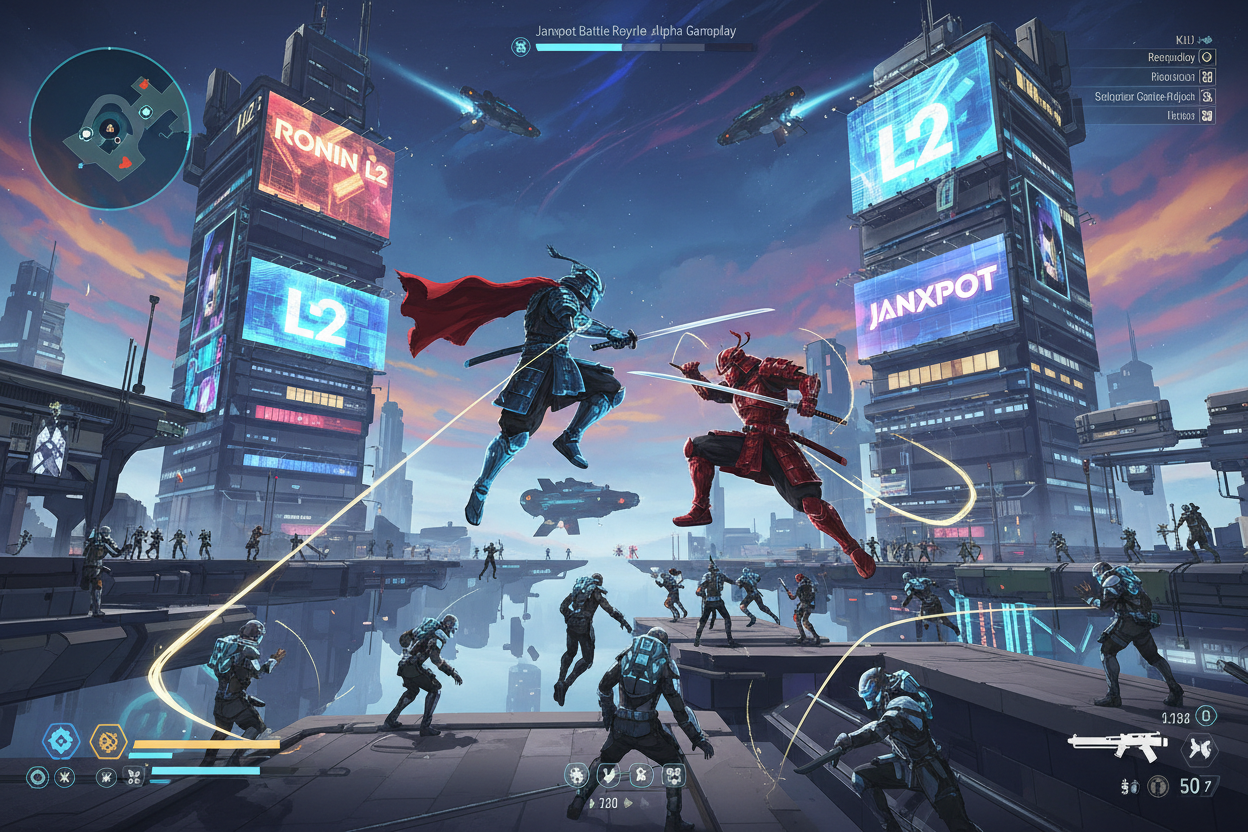
Players won’t notice the blockchain hum beneath the surface, but they’ll feel the seamless progression: no more rage-quits from failed trades or delayed revives. This elevates Ronin L2 battle royale from experimental to mainstream contender, attracting talent from traditional studios eyeing Web3 monetization without compromises.
Gaming ecosystems thrive on network effects, and Ronin’s upgrades- backed by proposals from Optimism and others- position it to capture share from fragmented L2s. For investors, RON at $0.0960 undervalues this trajectory, especially as throughput scales to one million tx/s. AInvest highlights efficiency gains for NFT-heavy apps, extending to battle royale cosmetics and land claims in expansive metas.
Do Ronin L2’s 100-200ms blocks and progressive decentralization outweigh sequencer risks for games like Janxpot Battle Royale?
Ronin transitions to L2 rollup for ultra-fast Web3 gaming (up to 1M TPS). Amid BitPinas community optimism and dev focus on scalability, what’s your take? RON: $0.0960 (-0.0231%).
Layer-2 speed races, as Ventureburn details for crypto UX, extend to gaming’s frontlines. Ronin leads by blending zkEVM security with OP Stack familiarity, ensuring developers port dApps effortlessly. The Crypto Recruiters’ guide reinforces L2s as Ethereum’s scalability engine, and Ronin exemplifies this for gamified futures.
RON’s resilience at $0.0960 amid market whispers underscores conviction in this infrastructure bet. As Q2 2026 nears, expect Janxpot Battle Royale on Ronin L2 to spearhead a wave where blockchain fades into the background, letting adrenaline-fueled combat take center stage. Gamers and builders, equip accordingly- the drop is imminent.
About the Author